
In recent years, TECHO responded to an increasing number of emergencies caused by extreme weather events. From building emergency housing to implementing community infrastructure projects, the organization now recognizes that the housing agenda must be directly linked to climate adaptation and resilience.
It is in this context that the project emerges Resilient Housingproject—a housing model that combines technological innovation, sustainability, and community participation, based on TECHO accumulated experience TECHO Latin America and the Caribbean.
The project is a practical response to heavy rains, floods, heat waves, strong winds, and other impacts that already affect millions of people on a daily basis—people who remain invisible, living in substandard housing, often without bathrooms or basic sanitation.
👉 TECHO the ROOH campaign to build resilient homes
👉 TECHO has become an official member of Race to Resilience, an initiative of the UN Climate Champions Global Campaign.
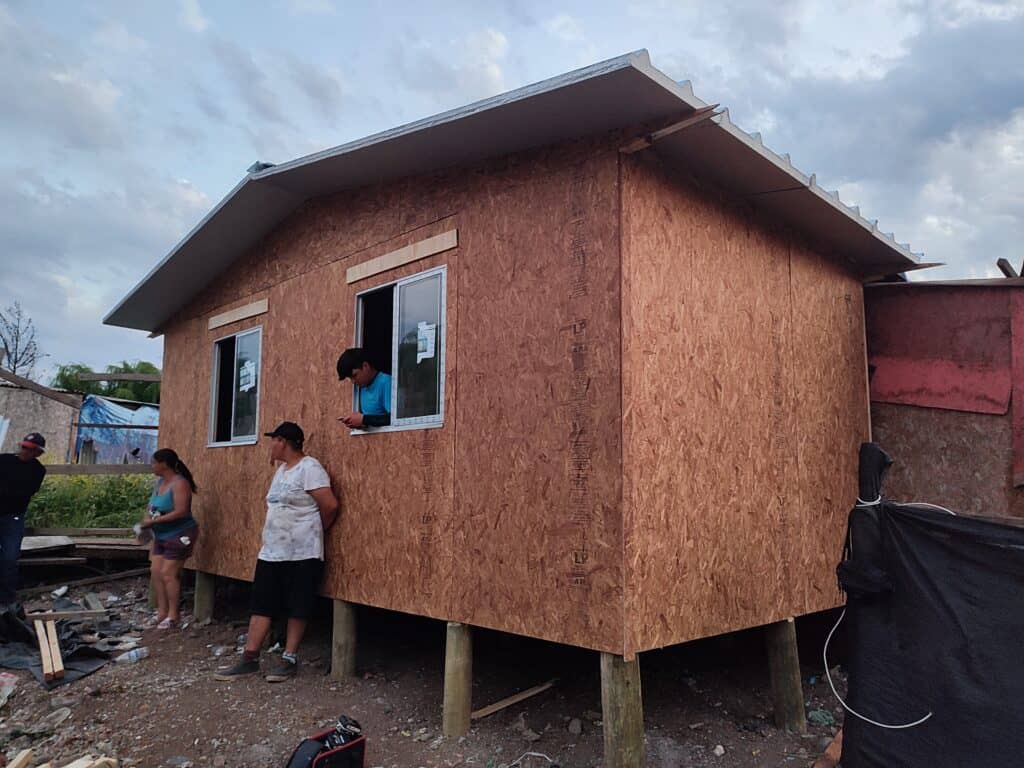
This model offers an immediate and concrete solution: temporary, affordable, and sustainable housing designed to protect the most vulnerable communities from the impacts of climate change. Its innovative approach combines technical expertise with modular and recycled materials, thermal comfort, cross-ventilation, and flood resistance, as well as community participation, since families, community leaders, and volunteers work together to build each home.
In 2024, the project was implemented in six countries: Argentina, Brazil, Chile, Colombia, Peru, and Mexico.
“We built the house together with the volunteers in two days, and on the third day it rained quite a bit. If I had been in the makeshift house, I would have lost everything.”
– Mirielle, on the impact of her Resilient Home.
Key Findings:
The main conclusions of the Resilient Housing Report, based on a pilot project in six countries (Argentina, Brazil, Chile, Colombia, Mexico, and Peru), were:
- The project underscores the urgent need to integrate climate justice and the right to housing, promoting participatory and sustainable solutions.
- The results are highly satisfactory and demonstrate the potential to replicate these models in other communities to build safer and more resilient settlements.
- Theimportance of continuing to research and develop innovative solutions that optimize costs and ensure the scalability of Resilient Housing in the region is emphasized.
Vulnerabilities and deficiencies in existing housing:
Most families live in homes that do not protect them: 87% say their homes are in poor condition and unprepared for the effects of climate change. 94% of communities have recently experienced extreme weather events. Leaks, dampness, structural instability, and lack of insulation are everyday problems. Even with creative solutions devised by the families themselves, these are not enough to cope with increasingly intense events.
Design and development of resilient solutions:
The project focused on improving material selection and construction techniques. The proposals combine local and readily available materials with simple and innovative methods that enhance thermal comfort and durability while reducing environmental impact.
Cost Analysis:
Cost reductions were achieved in Chile (-15%), Colombia (-5%), and Mexico (-5%) thanks to the use of local, low-cost materials. In Argentina (+15%), Brazil (+15%), and Peru (+30%), costs increased due to the use of higher-quality materials that improve insulation and service life. Overall, the project struck a balance between cost, sustainability, and quality.
Prototype Development and Impact:
The prototypes demonstrated that it is possible to build practical solutions tailored to the local climate. Using simple processes, volunteers and families were able to construct the homes in just two days. The communities highlighted immediate improvements in comfort, protection, and durability, noting that these homes provide support and care, even in contexts of increasing climate risk.
And this is just the beginning. This 2025 TECHO one goal: to build 80 Resilient Homes in 6 Latin American countries.
This project underscores the urgent need to integrate climate justice and the right to housing, promoting participatory and sustainable solutions. To continue developing tangible and innovative responses—some of which can even be implemented within a few days—it is important that more and more sectors of society join in and become part of the change.
We believe in the power of action. With our feet firmly on the ground and our hands on the job, we discover the potential to achieve great things when we join forces.
→ If you're interested in learning more about Resilient Housing and want to be part of the change,contact us here.